- Why many investors are giving away returns
- Saving vs. investing: Protection against inflation
- Market vs. investors: Why many earn less than the market
- Volatility: Understanding price fluctuations
- Improve market timing: Don't miss out on the best stock market days
- Behavioral finance: How your emotions affect your money
- The 6 biggest investment mistakes
- Professional solutions for individual customers
Smart investing at a glance
- Saving alone isn't enough: If you want to preserve and build wealth, you need to invest in the long term.
- Market timing: The greatest losses in returns occur when investors enter the market too late during boom years and exit during crises.
- Broad diversification, a clear strategy and discipline are the foundation for better investment results.
- Avoid investment errors: Zurich offers professional investment solutions for investors, whether they have little experience or extensive experience.
Why many investors are giving away returns
Many people invest – yet in the end, they are left with less than the market actually would have yielded. The reason rarely lies in the products themselves, but rather in their own behavior: fear, greed and anxiety in uncertain times. It is when the stock markets are unstable and prices are fluctuating that costly mistakes occur, such as entering the market too late, selling too early or chasing trends.
In this guide, we explain
- which investment mistakes are costing you significant returns,
- what psychological patterns lie behind them, and
- how to get more out of your money in the long term and sustainably with a clear strategy.
Saving vs. investing: Protection against inflation
Money in a savings account feels safe. However, inflation gradually erodes its purchasing power. What you can still buy for CHF 100 today might cost significantly more in a few years. Simply saving money does not protect it from a loss of purchasing power.
It is important to invest because, even though share and fund prices fluctuate, historically they have generated significantly higher returns than traditional savings accounts over longer periods. This requires discipline. That means being able to withstand price fluctuations instead of reacting nervously to every little movement.
We explain the basics of investment opportunities and risks in an easy-to-understand way on the Investing and growing your money page.
Market vs. investors: Why many earn less than the market
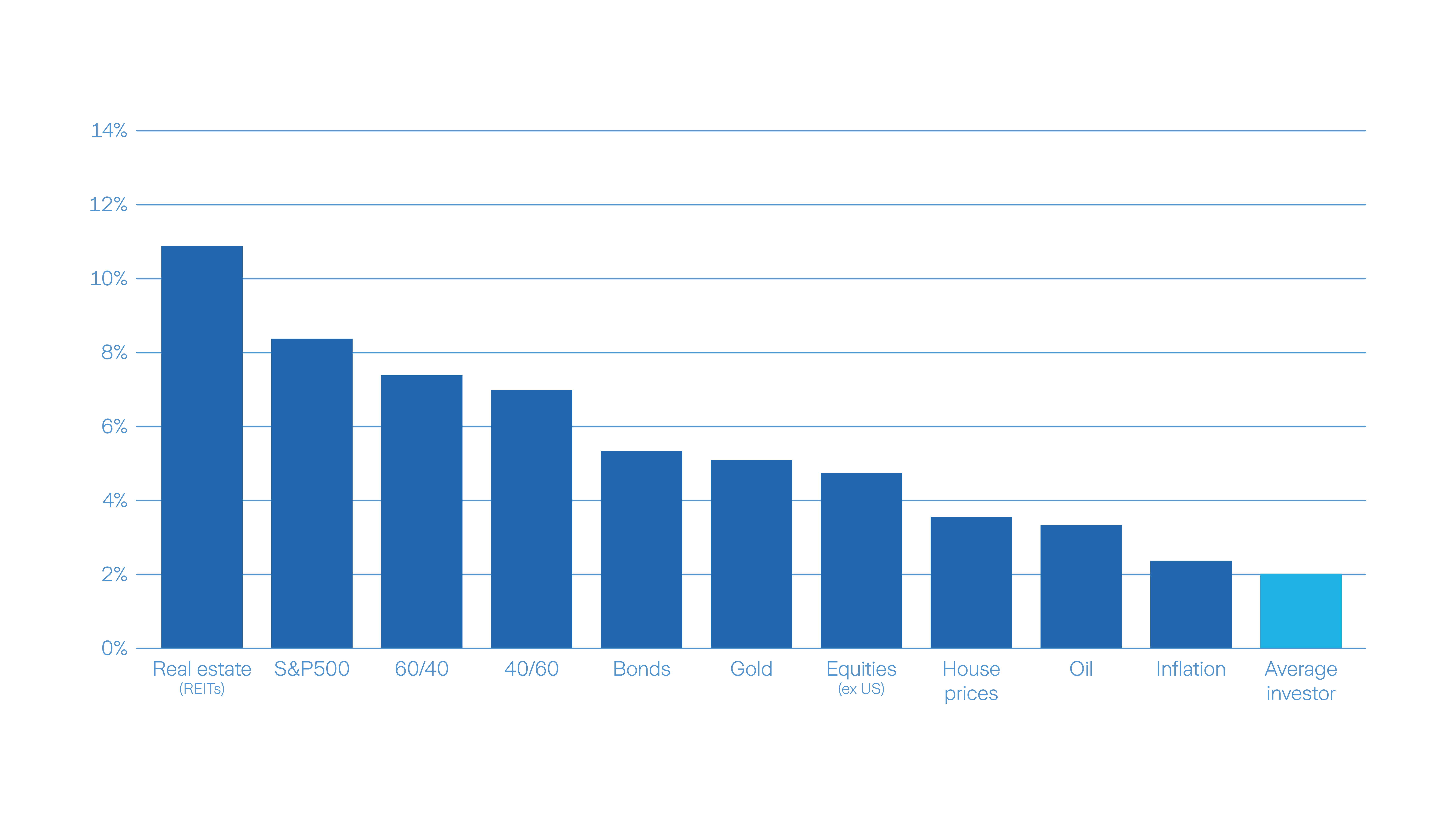
Many investors earn returns on their investments that are significantly below the average market return. For example, the market returns 5% – but the typical investor only earns 2%.
The reason is rarely bad luck, but rather poor timing:
- Jumping in when everyone's feeling euphoric
- Getting out when prices are falling and anxiety is rising
People who act this way often buy at too high a price and sell at too low a price. Exactly the opposite of what would make sense. This yield gap shows: The main problem isn't the market; it's our behavior. This is demonstrated, among other things, by the Dalbar study (see chart), which clearly shows that the performance of private investors is often worse than the market.

Volatility: Understanding price fluctuations
Share prices do not rise in a straight line. Periods of high gains are followed by declines of 40% or more. Nevertheless, the long-term trend is clearly positive. Such fluctuations are called volatility. They are not a sign that investing doesn't work; they are simply part of the market.
It only becomes a problem when investors get nervous at every dip and sell in a rush: Then temporary fluctuations turn into permanent losses.
Smart investors factor in such fluctuations and stick to their strategy, especially during turbulent times.
Learn more in our guide Investing safely during turbulent times.
Improve market timing: Don't miss out on the best stock market days
Many investors try to exit the market "in time" when things get turbulent – and re-enter as soon as things seem to be looking up. That sounds reasonable, but it often results in a massive loss of returns.
Studies show: Investors who miss the 10 or 60 best trading days over a long period will achieve a significantly lower return – in some cases, even a negative return. These 10 or 60 best days often occur during or shortly after crises.
What does this mean? Those who get out during a crisis often miss out on the recovery. Instead of limiting your losses, you're giving away the chance to profit from the days with the highest price gains. That's why, in most cases, it makes more sense to stay invested than to keep buying and selling based on gut feelings.
Behavioral finance: How your emotions affect your money
When it comes to our money, we rarely make purely rational decisions. Our psyche is always a factor. This is where behavioral finance comes in. Loss aversion and herd mentality are two typical behavioral patterns among investors:
- Loss aversion: People feel the pain of losing CHF 10,000 much more intensely than the joy of gaining CHF 10,000. That is why many investors sell in a panic during a crisis – precisely when a level head is needed.
- Herd mentality: "Everyone's selling – I have to get out" or "Everyone's talking about this stock – I have to buy it" – those who follow the crowd (instead of their own strategy) are usually too late.
Other costly human weaknesses include the fear of missing out (FOMO), greed and overconfidence. They are often fueled and intensified by panic ("I have to get out before things get even worse") or hype ("I'm jumping on board before the train leaves without me").
Such emotions are normal and human. It is important to understand them and not to buy or sell rashly because of every short-term fluctuation in market sentiment. A clear strategy helps us recognize and understand our feelings – but not be guided by them.
The 6 biggest investment mistakes
Emotions are the main cause of many investment mistakes, not a lack of knowledge or poor investment choices. Avoid these 6 investment mistakes that could cost you a lot of money:
- Doing nothing or waiting too long
Out of fear of taking a risk, money stays in the savings account. Not investing is the biggest risk. Having money in the bank feels safe, but inflation slowly erodes your wealth. Those who don't invest are permanently forfeiting their opportunities for returns. - Buying high and selling low
In theory, all investors know better. Nevertheless, many people make the same mistakes: They buy at high prices when market sentiment – and thus prices – are high (driven by greed and the fear of missing out), and sell at low prices when prices fall (driven by fear and panic). This turns the idea of "buying low and selling high" into exactly the opposite. - Missing out on the best recovery days
Those who sell during a crisis, and who wait to re-enter the market until sentiment improves, often miss out on the best days of the recovery. The result is a noticeable return gap compared to investors with a clear strategy who remained invested (and even bought more at lower prices). - Not diversifying investment risk broadly enough
Not investing is the biggest risk. The risk of betting everything on a single share, industry or trend is almost as great. Experienced investors diversify their portfolios broadly, spreading out risk and thereby minimizing the impact of fluctuations in a particular share, industry or trend on their overall portfolio. - Not creating an investor profile
Anyone who tries to achieve very short-term goals with risky investments or long-term goals with conservative investments will often fail. The foundation for the investment strategy – and thus for every investment decision – is an investor profile that answers these questions, among others:
- How much risk can you and are you willing to take?
- What are your investment goals?
- How much time do you have to achieve these goals? - Following the herd instead of thinking for yourself
Many investors blindly follow tips from friends, the Internet or the media without questioning them or checking whether they're a good fit for their own situation. Herd mentality replaces independent analysis and can easily lead to costly mistakes.
Smart investing: 5 valuable tips
To turn your good intentions into measurable results, you need just a few rules – and discipline.
- Strategy instead of gut feelings:
Determine what you are investing for (goal), how long you want your money to work for you (time horizon), and how much risk you can or are willing to take. An investor profile helps you stick to what makes sense in the long run during turbulent times. - Buy and hold instead of panicking:
Price declines of up to 40% are unpleasant, but they do happen. It is important to view such phases as part of the journey, not as a reason to abandon the strategy. Those who continue to invest in a disciplined manner have a better chance of benefiting from the recovery. The behavior of investors leads to vastly different outcomes. Discipline and perseverance are crucial if you want to invest your money wisely. - Diversify instead of placing single bets:
With funds and balanced portfolios, you can diversify your investments across different asset classes, sectors and trends. Diversification minimizes the risk that a single bad investment will negatively impact your entire portfolio. - Reinvest instead of withdrawing:
Payouts such as dividends or interest are an important part of your total return. Those who consistently reinvest their earnings, rather than spending them, take advantage of the compound interest effect – which many people underestimate – and grow their wealth much more efficiently. - Higher returns, not higher costs:
Frequent buying and selling results in unnecessary fees and taxes. Investors who trade less and hold their investments for the long term can lower their costs and increase their returns without incurring additional expense or risk.
You can put these tips into practice, for example, with 3b investment funds for broadly diversified fund investments, the CapitalFund single premium option for larger one-time contributions or structured products that offer capital protection and the potential for returns. We explain how on the page Investing and growing your money.
Professional solutions for individual customers
With the right strategy and guidance, you can avoid many common investment mistakes. This is where Zurich steps in – with solutions that would otherwise be difficult for most private customers to access. Here's why you should take your time to explore our solutions:
- Economies of scale like pension funds
Zurich pools large amounts of investment capital and offers private customers the same professionally managed asset classes that institutional investors use. - Independent fund selection
We are not limited to our in-house funds; instead, we select suitable investment managers, from our perspective. This allows us to build a broadly diversified portfolio that is not dependent on individual securities or trends. - Attractive terms and a high level of security
Large investment volumes enable favorable terms, and both Zurich Life Insurance Company Ltd and Zurich Invest Ltd are regulated by FINMA. Our investment process is clearly structured and transparent.
If you would like to have a large portfolio professionally managed, we also offer our asset management solution. For investable assets of CHF 100,000 or more, our specialists will handle the day-to-day management of your portfolio and ensure that your investment strategy is consistently followed. With Zurich's asset management services, you can benefit from the principles described in this article without having to worry about making investment decisions yourself.
With professional support from
As a technical expert at Zurich, he contributes his expertise in retirement provision and investments.
With professional support from
Andreas Stocker
Product & Proposition Manager
As a product and proposition manager at Zurich Invest Ltd, he contributes his expertise in capital market solutions, product structure and risk/return strategies.