- No to a Switzerland with 10 million: What's it all about?
- How will Switzerland develop demographically by 2050?
- The three scenarios of the Federal Statistical Office
- Proportion of older people will increase significantly
- Fewer people in work – more retired people
- Population aging and the intergenerational contract: What are the consequences?
- Elderly Switzerland: What will it look like?
- Recommendations for personal retirement provision
No to a Switzerland with 10 million: What's it all about?
In June 2026, the Swiss population will vote on the popular initiative "No to a Switzerland with 10 million." This calls for the Swiss resident population to be limited by law to 10 million people up to 2050. If the vote is accepted, immigration would have to be limited once a figure of 9.5 million is reached.
How will Switzerland develop demographically by 2050?
Regardless of the current political debate: What demographic development can we expect to see in the next 25 years or so? And what do the trends mean for the individual retirement provision situation of all of us?
The three scenarios of the Federal Statistical Office
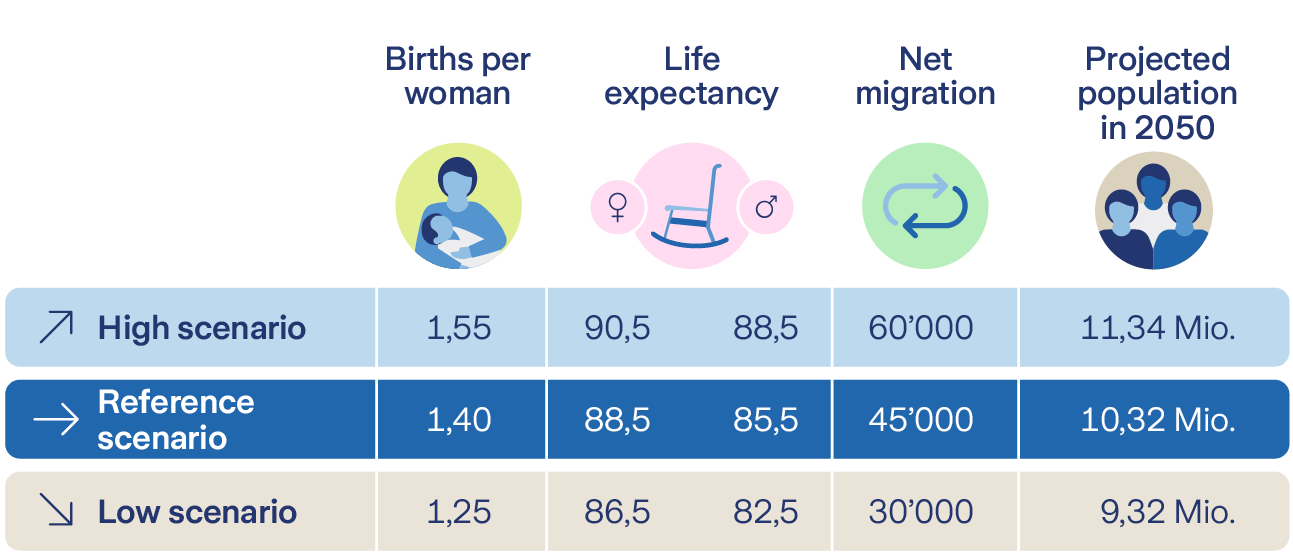
According to the latest population growth scenarios from the Federal Statistical Office for 2025, there will probably be – without any far-reaching political intervention – between 9.32 and 11.34 million people in Switzerland by 2050, with the most likely scenario assuming 10.32 million people. The scenarios depend primarily on three factors: birth rates, life expectancy and immigration.
Demographic change: Average age will rise
Based on the reference scenario, it is already clear that the age structure of the population in Switzerland will change significantly. Instead of the classic "population pyramid" with many young people and fewer old people, the most populous age groups are increasingly in the middle or advanced age ranges.
From 2035, there will be more deaths than births
The reference scenario assumes that, from 2035, more people will die in Switzerland than will be born – due to the increasingly older population and low birth rates. Specifically, in the reference scenario, it is expected that there will be around 89,000 births in 2055, compared with 107,000 deaths.
Immigration is slowing down – increasing competition for talent
At the same time, it is expected that more people will continue to immigrate to Switzerland than emigrate (positive net migration). However, according to the forecast of the Federal Statistical Office, this trend will weaken. This is because the population is also aging in many other European societies. This is leading to increasing competition for young workers in the European labor market. For this reason, the Federal Statistical Office only expects annual "net migration" (number of immigrants minus number of emigrants) of 45,000 people per year in the long term.

Proportion of older people will increase significantly
In any case, the proportion of older people will increase significantly, according to the Federal Statistical Office: "In all scenarios, the over-64 age group will increasingly outweigh people of working age." In contrast, there are clear differences between the scenarios for the young age groups – i.e. children and young people under the age of 20 – depending on the birth rate and immigration factors: The more births and immigration there are, the more children there will be – because immigrants are mostly young adults.
Fewer people in work – more retired people
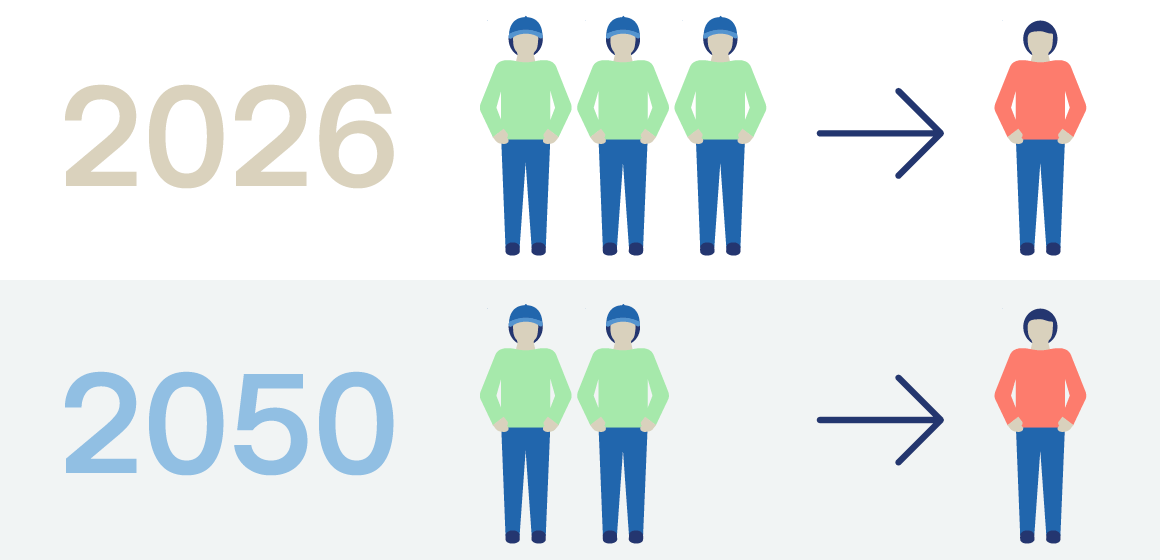
At the same time, the old-age dependency ratio will increase. This describes the ratio of people of retirement age (65+) to people of working age (20 to 64). From 2025 to 2050, the ratio is likely to shift from 33 to 100 to 43.3 to 100.
This means: Today, three working people have to finance one pensioner; by the middle of the century, the ratio is expected to be close to two to one.

Population aging and the intergenerational contract: What are the consequences?
If fewer and fewer young people have to finance more and more older people, this is a challenge, especially for state retirement provision, as this is based on the pay-as-you-go system: Everyone pays into the same pot, from which pensions are then financed directly. The problem is less pronounced in occupational and private retirement provision, where everyone saves for themselves in principle. This is particularly important because increasing life expectancy means that money must last longer in old age.
Elderly Switzerland: What will it look like?
If the proportion of older people in the overall population continues to rise, and they become significantly older at the same time, the pressure on the workforce and on social systems will increase. A growing proportion of older people means an increase in demand for medical and nursing care with the corresponding specialists. The aging population is also increasingly dependent on specially designed infrastructure, e.g. accessible apartments. It is possible that the lack of young employees will reduce innovation capacity, and there will be less progress and change. This could also jeopardize Switzerland's economic position in the medium term.
Recommendations for personal retirement provision
Regardless of how the vote is decided in June 2026, it is advisable for everyone in Switzerland to prepare for the demographic challenges. This applies in particular to personal retirement provision:
- Private retirement provision: Even today, state and company retirement provision alone can only cover around 60% of the current standard of living. Private retirement provision is therefore needed to close the income gap. This is likely to become considerably more important in the future.
- Save early: If you start building up your private retirement provision early, you can benefit all the more from the compound interest effect and make more of your money.
- Regular retirement provision analysis: Individual retirement provision advice is particularly valuable in times of change – at all stages of life. Young people can use this to set the right course for their personal retirement provision. In the case of significant life events, such as buying a house or starting a family, good advice can help close potential pension gaps. And when it comes to retirement, pension planning makes sense in order to enjoy financial freedom in the third phase of life.
Conclusion: Those who address the topic now will remain independent and financially secure in the future.
Get advice
Would you like to know where you stand when it comes to retirement provision? At Zurich, we provide you with committed and comprehensive advice. Contact us!
The sound planning of personal retirement provision is more necessary today than perhaps ever before. After all, it is clear that the current demographic development presents us with major challenges. This makes it all the more important to make individual provisions and shape your own future. Because the more options you have, the better you can react to changes.
Expert commentary by Peter Spycher, specialist for retirement provision and investment advice at Zurich Switzerland:
With professional support from
As a technical expert at Zurich, he contributes his expertise in retirement provision and investments.