Replacement value or cash value – what applies in the event of a loss?

After a claim, a crucial question quickly arises: How much does the insurance company actually pay? The terms replacement value and cash value play an important role here. This guide explains what these values mean, when they apply, and how you can optimize your insurance coverage accordingly.
An antique chair that has been restored on one side but not on the other.

These values insured determine your compensation

Whether it's water damage in your home, a broken television after an accident, a bicycle stolen from the cellar, or a total loss of your car: If something is damaged or lost, you quickly ask yourself what costs are covered by the insurance.

Will the replacement value of an item be reimbursed, i.e. the price of a new product? Or does the insurance only pay the cash value, which takes age and wear and tear into account? The value insured determines the amount of compensation in the event of a loss, taking into account the deductible.

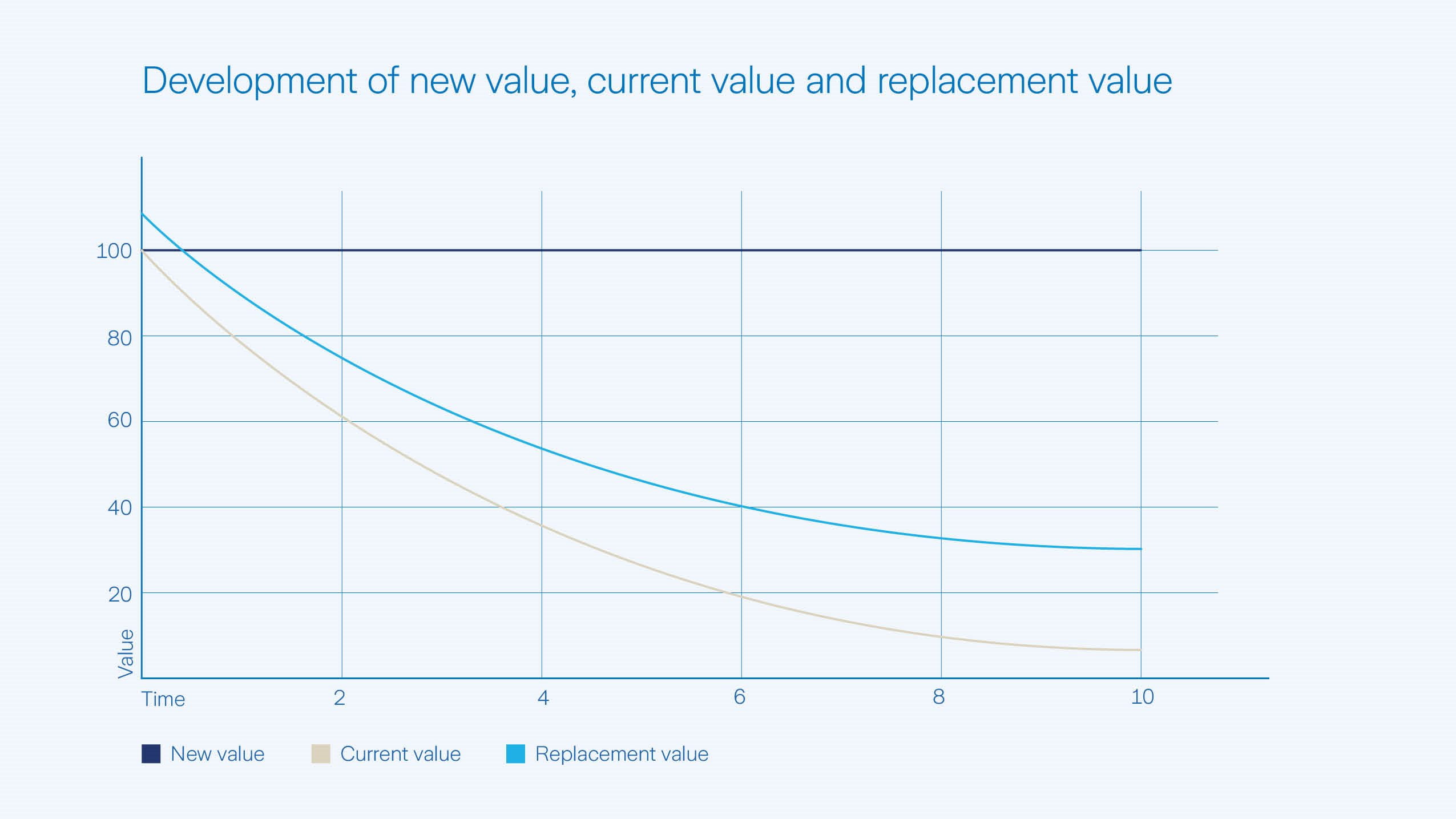
Replacement value and cash value over time

While the replacement value generally remains constant, the cash value decreases with increasing age and use of an item. The following graph shows in simplified form how the replacement value and cash value develop over time. 

Chart on Replacement Cost, Market Value, and Fair Market Value
  • Replacement value remains constant until the first loss in value
  • Cash value decreases with increasing age

Value insured explained simply

Replacement value – replacement with a new product

The replacement value is the amount you need to replace a damaged, destroyed or stolen item with a new one of the same value.

Example: If your TV is damaged by water, your insurance will reimburse the amount that a comparable new set costs today, taking into account the deductible.

Replacement value cover is typical for:

  • Household contents insurance
  • Buildings insurance

The advantage: You can replace the damaged item with a new product without having to bear the loss in value due to age or use.

Cash value – current value based on age and use

The cash value takes into account the loss in value of an item due to age, use and wear and tear.

The simplified calculation is as follows: New value – age-related depreciation = cash value

Example: A new laptop costs CHF 1,500. After several years of use, its cash value may only be CHF 400. In the case of cash value compensation, the insurance company would provide this cash value, taking into account any deductible.

Cash value compensation is particularly common for:

  • Liability claims

The approaches at a glance

Value insured What does that mean? Example in the event of a loss
Replacement value Compensation corresponds to the price of an equivalent new item today. Your 5-year-old television is destroyed by water damage. The insurance company pays for a new television with comparable features..
Cash value The current value of an item, taking into account age and wear and tear. You damage a friend's 4-year-old laptop. Liability insurance covers the cash value of the device, not the original purchase price.

Which Zurich insurance pays what value?

The value you receive from Zurich in the event of a loss depends on the insurance cover you choose. If an item or your building is insured at replacement value, the replacement value will be reimbursed in the event of a loss. With cash value insurance, on the other hand, you receive the cash value of the damaged or lost property. You should therefore carefully check which cover makes sense for your situation when you take out the policy. 

Household contents insurance

As a rule, replacement value cover applies for household contents insurance.

This means: if your household contents are damaged or stolen, the insurance will reimburse the amount you need to buy new items of the same value.

Household contents include, for example:

  • Furnishings
  • Clothes
  • Electronic devices
  • Household appliances

It is important that the sum insured is set sufficiently high. Only then can the claim be fully compensated. 

Exception for caravans and mobile homes. If caravans or mobile homes are included in the household insurance, compensation is paid at cash value.

More about Household contents insurance.

Buildings Insurance

Buildings are usually insured at replacement value.

In the event of a loss, the insurance covers the costs of rebuilding or restoring an equivalent building at the current construction value.

Certain technical building systems, such as photovoltaic systems, can also be insured against internal and external damage. If such a system is damaged, the compensation in the event of a loss is based on the age of the system.

More about Buildings Insurance.

Motor vehicle insurance

The types of compensation in motor vehicle insurance determine how much is compensated in the event of a loss:

  • Replacement value compensation: in the event of a total loss, the amount paid out is the amount that the vehicle would have had in brand-new condition. Replacement value compensation is often only valid for a limited period after initial registration (12 or 24 months).
  • Purchase price protection/purchase price guarantee: is available as additional cover for new or used cars. The maximum compensation is the purchase price paid, for 5 years from the date of purchase.
  • Cash value plus supplements: this is the most common type of compensation for vehicles up to the 7th year of operation. The cash value plus supplements is defined in a table. Compensation in the event of a total loss is calculated as a percentage of the original new value of the vehicle and is based on the respective year of operation. Thanks to the cash value plus supplements, the compensation is significantly higher than the pure cash value of the vehicle.
  • Cash value or replacement value: these types of compensation apply to older vehicles from the 7thyear of operation.

More about Car insurance.

Well prepared in the event of a loss

To ensure that your claim can be processed quickly and easily, it is helpful to have important information handy:

  • Proof of purchase or invoices
  • Photos of the affected objects
  • Information on make, model and age
  • For vehicles: service booklet and mileage
  • For valuables: certificates or expert opinions

A practical tip: save important documents and photos digitally so that they are always available in the event of a loss.

Individual advice for the right insurance coverage

If you are unsure which cover makes sense for your situation, it is worth seeking personal advice. Together, we will clarify which insurance coverage best suits your life and your needs.

Contact form