What Switzerland thinks about financial security and retirement provision

"How will I fare in old age?", "Can I still maintain my standard of living?" or "Are there any events that could jeopardize my future plans?" – such questions are currently a major concern for people in Switzerland, according to a key finding of the newly published "Security Study 2026." The Sotomo research institute produced this study in collaboration with Zurich Switzerland.

A hand holds two people sitting side by side and half of a sphere.

Uncertainty: Will I be able to maintain my standard of living in old age?

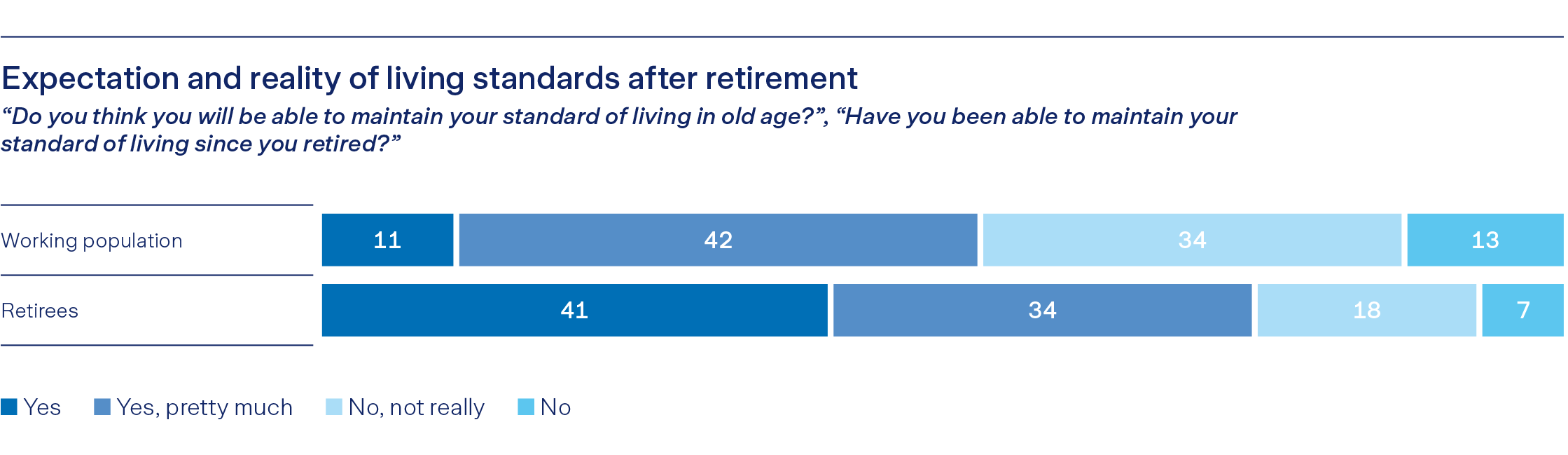
This year, the Security Study takes a close look at how people in Switzerland are planning for the future. An important aspect of this is concern about the standard of living they will enjoy after retirement: Only 46% of the working people surveyed feel secure with regard to their financial cover for old age – around half feel insecure. Similarly, only just over half of the working population (53%) expect to be able to maintain their standard of living in old age. Only 11% are sure of this.  

Standard of living: Retired people are more optimistic than the working population

Current retirees, on the other hand, paint a much more positive picture: Three quarters of them (75%) state that they have been able to maintain their standard of living since retirement. Those currently in employment are therefore much more pessimistic about their financial future than retirees are about their financial present. This is hardly surprising, as today's retirees often retired under more favorable conditions.  

Chart shows expectations and reality of living standards after retirement with bar graphs.

The biggest concerns of the working population

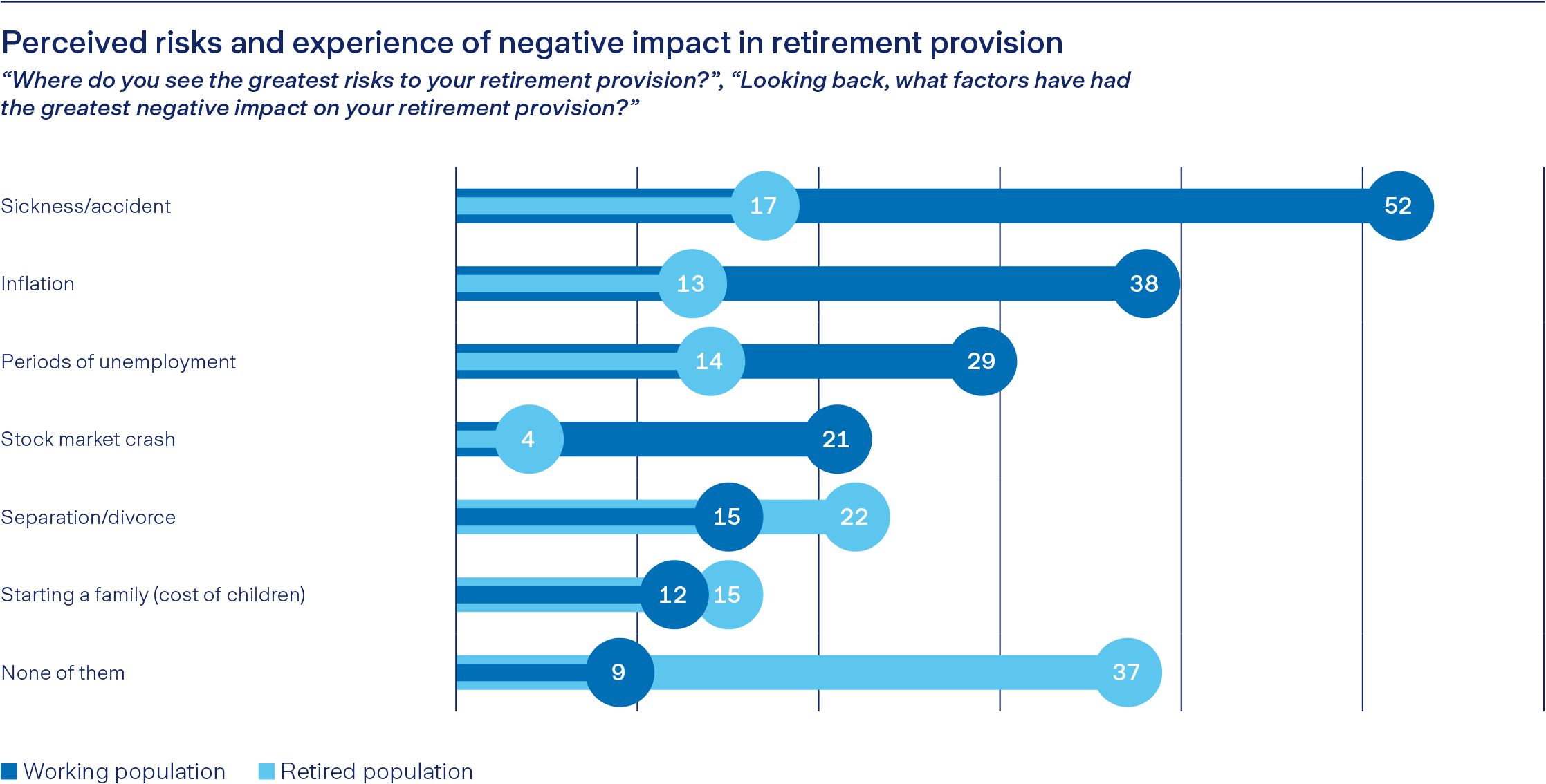
The working population sees sickness and accidents as the greatest risk to their own retirement provision: 52% of respondents mention this factor. Concerns about inflation (38%) and periods of unemployment (29%) are also widespread. A stock market crash as a retirement provision risk is feared by 21%. 

Risks for retirees in reality

Looking back, retirees have a different view: They most frequently cite separation or divorce (22%) as an impairment to their retirement provision, followed by sickness and accident (17%), starting a family (15%) or periods of unemployment (14%). 37% have not experienced any significant impairment of their own retirement provision, compared with only 9% of those in employment. "The concerns of those in employment are therefore significantly greater than the actual impairments experienced by today's retirees. It appears that the current generation of workers are gearing themselves up for more difficult conditions for their retirement provision," comment the authors of the Security Study.  

Act early – and mitigate risks

However, even though retirees assess many risks more positively in retrospect than those in employment, they still consider the risks of divorce, sickness or accident, starting a family and unemployment to be significant. This is impressive proof of the need for pension advice. While it is true that you can only insure yourself directly against sickness and accidents, the impact of other life events can also be at least cushioned with early retirement planning and consistent action.  

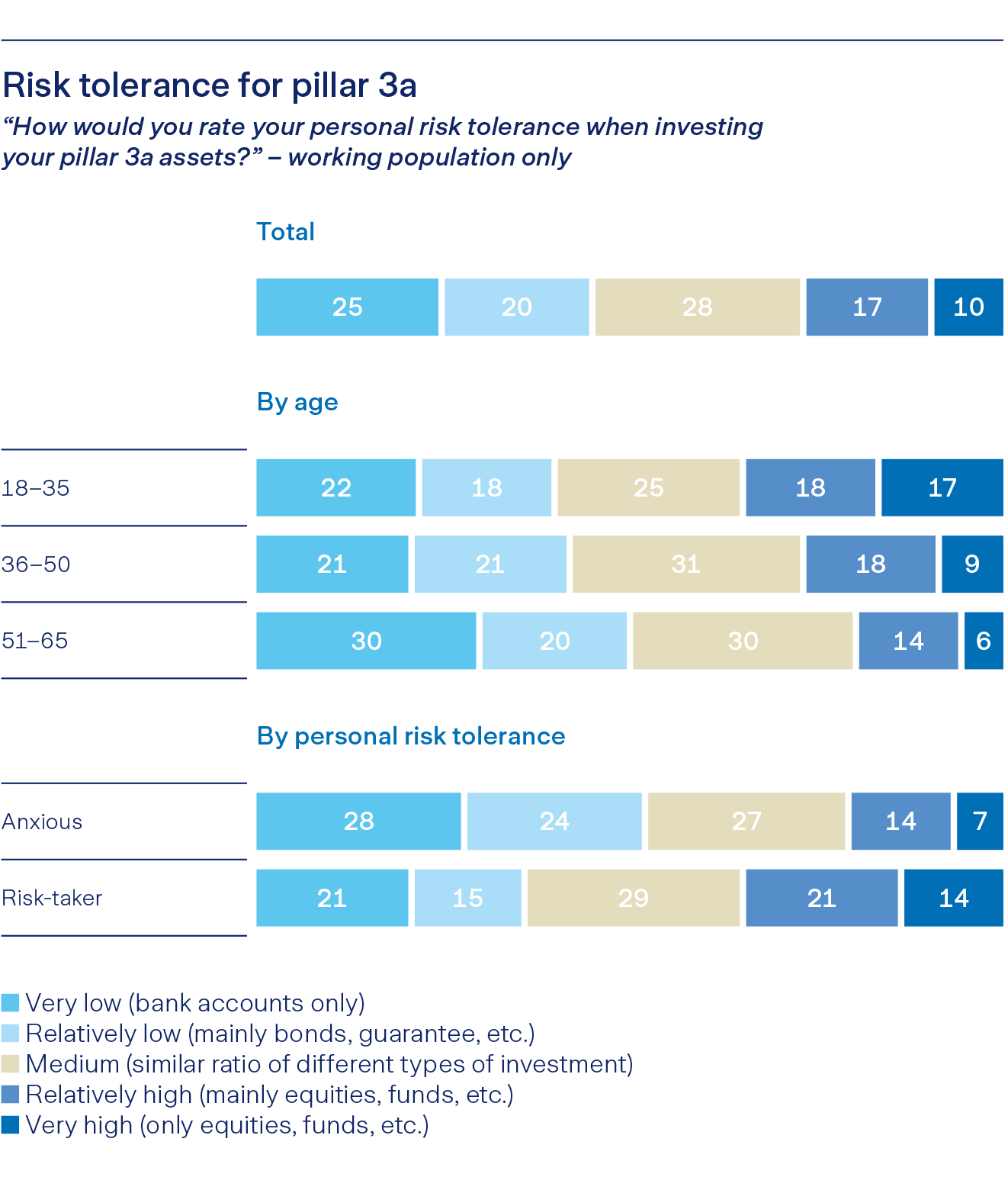
A chart showing risk willingness in investment for different age groups and risk preferences.

Investment strategy: Conservative

It is interesting to note that, while 21% of those in employment fear a stock market crash, only 4% of retirees have actually had relevant losses. This risk is therefore obviously greatly overestimated. This is in line with the fact that the Swiss working population generally tends to invest relatively cautiously – and thus gives away a lot of potential returns, particularly with longer-term investments. The desire for security therefore turns into a risk of missed opportunities for returns. 

Young people take more risk with pillar 3a

In the case of pillar 3a assets invested for a very long time, around 45% choose a low or very low risk profile, while only 27% opt for a high or very high risk. All the same, 35% of 18- to 35-year-olds choose a higher risk, compared with just 20% of 51- to 65-year-olds. This reflects the longer investment horizon of younger people: They are better able to compensate for price fluctuations in the long term and are therefore more willing to invest in equities. In addition, younger people are more likely to use digital pension solutions that simplify access to securities solutions.

Chart showing risks and impacts on retirement savings, featuring various categories and percentages.

Conclusion

People in Switzerland believe that there is a great need for action when it comes to retirement provision: More than half of them fear that they will no longer be able to maintain their standard of living in old age. A similar number of people identify sickness or accident as the greatest risk to their personal retirement provision. This can literally affect anyone.  

"Despite these concerns, the majority invest their private retirement assets in relatively low-risk investments. In view of the long investment horizon, however, it is precisely this caution that can pose a risk to adequate retirement provision," concludes the Security Study. The key challenge is to find the right balance between risk and return: "Security doesn't just mean avoiding risks but also taking the right risks at the right time." 

Actively shaping the future with Zurich

Comprehensive retirement provision advice is valuable in order to make the right decisions for your financial future. Zurich's experts provide committed and competent advice on all matters relating to retirement provision and pension planning. 

Arrange a consultation now
Woman and man with dog in pension consultation

Personal pension advice
Do you have questions about your retirement provision? Our advisors will answer your retirement provision questions in a personal meeting. Free and with no obligation.