- Electromobility is booming in Switzerland
- Electric car or combustion engine? The comparison in everyday life
- Everyday life with the electric car: tips and advantages
- Practical tips for switching to an electric car
- Zurich services and offers for e-mobility
- Frequently asked questions about electromobility
Electromobility is booming in Switzerland
Mobility in Switzerland is changing: in 2024, over 143,000 vehicles (source: Federal Statistical Office (FSO), number of motor vehicles by propulsion type, as at the end of 2024) with alternative propulsion systems were newly registered. This means that almost one in five cars is now electric or hybrid. An important driver of this development is the increasing cost-effectiveness of electric cars. Price differences when compared with conventional vehicles with combustion engines are shrinking, while operating costs are falling noticeably.
Thanks to a clean electricity mix, short driving distances, and a steadily growing charging infrastructure, Switzerland offers ideal conditions for the switch to electromobility.
Electric car or combustion engine? The comparison in everyday life
| Criterion |
Electric car / plug-in hybrid | Internal combustion engine (gasoline/diesel) |
| Carbon footprint |
No direct CO2 emissions while driving |
CO2 emissions while driving |
| Environmental footprint |
Progress in battery production and recycling |
Less complex production, but operation generates exhaust fumes |
| Noise |
Quieter, fewer vibrations |
Loud engine and more vibrations |
| Flexibilität | Over 9,000 public charging points, charging station at home |
Gas stations available nationwide |
| Range |
250–500 km (PHEV up to 1,000 km) |
High, depending on model |
| Cost | Higher purchase price, but lower operating costs and eco-bonus with Zurich |
Tends to be cheaper to purchase |
Short and compact
For everyday life in Switzerland – with comparatively short driving distances, clean electricity and a good charging infrastructure – the electric car is a climate-friendly and future-proof alternative for many people today. Combustion engines still score points for long distances and maximum flexibility, but the advantages of electromobility are constantly growing.
Everyday life with the electric car: tips and advantages
Your mobility behavior is crucial
Those who commute daily have different requirements in terms of range and charging time than those who mainly drive short distances. Charging behavior also plays a role: do you have access to your own charging station, or are you reliant on public charging points?
You should consider these aspects when making your decision:
- Average distance traveled per day
- Charging options at home and on the move
- Battery size and charging speed
- Space required for family, baggage or leisure
Good to know: Most modern electric cars now have ranges of between 250 km and 500 km. Plug-in hybrids combine electric and conventional propulsion systems and, as a result, can also cover longer distances.
Why electric and hybrid cars are attractive for Swiss commuters
- Low everyday costs
For commuters who regularly drive short distances, electric cars offer a cost advantage over vehicles with combustion engines thanks to low electricity prices and lower maintenance costs. In Switzerland, you can often drive 100 km on electricity for less than CHF 3. - Quiet and comfortable driving experience
Electric and hybrid vehicles drive almost silently and cause hardly any vibrations. This makes the daily commute to and from work noticeably more pleasant. - Climate-friendly driving
Around 75% of Swiss electricity comes from renewable sources. This makes commuting with an electric vehicle particularly low-emission and environmentally friendly. - Flexibility through hybrid models
Plug-in hybrids are ideal for mixed driving profiles: short distances can be covered entirely by electricity, while the combustion engine offers additional range for longer journeys. - Financial benefits
Electric and hybrid vehicles benefit from tax breaks in many cantons and can save additional costs through special insurance offers – such as Zurich's eco-bonus.
Conclusion: electric and hybrid cars offer numerous advantages for Swiss commuters. They are quiet, cost-efficient, climate-friendly, and offer attractive tax and insurance benefits.
Practical tips for switching to an electric car
Proper battery care
A healthy charging range is ideally between 20% and 80%. If you pay attention to this, you can extend the service life of your battery significantly. Frequent fast charging, on the other hand, should be avoided as it puts more strain on the battery.
You can find further information in the e-car battery guide
Efficient driving
With just a few adjustments to your driving behavior, you can get more out of every charge:
- make use of recuperation – the recovery of energy when braking.
- Activate energy-saving mode if available.
- Drive calmly and proactively, avoid unnecessary baggage.
Detailed tips on this can be found in the recuperation guide for electric cars
Charging at home and on the go
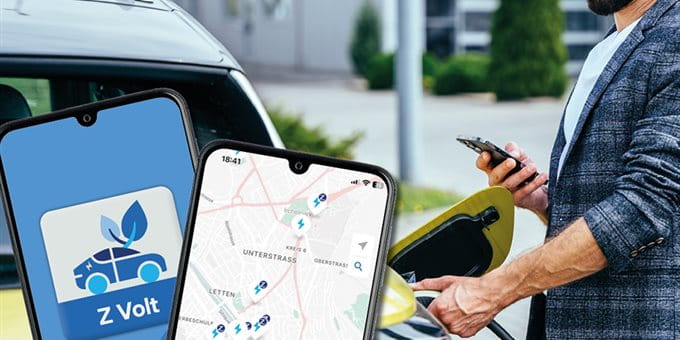
The most convenient way to charge your electric car is at home using your own charging station – usually cheaper than on the road. However, charging via the household socket should only be carried out after consultation with a qualified electrician. A dense network of public charging stations is available in Switzerland – many of which you can easily find using the Z Volt app.
You can find more information in the guide: Charging an electric vehicle – costs and savings tips
Take advantage of subsidies and savings opportunities
Depending on your canton of residence, you can benefit from state subsidy programs when buying an electric car or installing a charging station. Motor vehicle tax is also cheaper for e-vehicles in many cantons. With Zurich, you also benefit from attractive insurance offers: with the eco-bonus, you receive a reduction of up to 20 percent on your premium for your environmentally friendly vehicle, based on the type of propulsion system.
Overview of all funding programs in Switzerland: Energiefranken.ch

Zurich services and offers for e-mobility

Tailor-made protection for modern vehicles
Optimally insured for the mobility of tomorrow: with special additional cover such as E-Mobility Protect, Zurich offers tailor-made protection for electric and plug-in hybrid vehicles.

Simple charging – everywhere and without a subscription
With the Z Volt app, you can find over 3,700 partner charging stations in Switzerland and Europe. Charge at a single price, without a subscription or basic fee – directly via your smartphone.

Cover for driving third-party vehicles
Even if you don't own a car, with Zurich, you can take out optimum cover when car sharing or driving other people's vehicles – flexibly and reliably.

Cover for journeys on 2 wheels
Whether for the commute to and from work or in your free time: with Zurich, your e-bike is comprehensively covered – this includes protection against theft, accidents and damage to the battery.
Frequently asked questions about electromobility
Are you thinking of buying an electric car or a plug-in hybrid? Our answers to frequently asked questions will help you make the right decision.
How eco-friendly are electric cars really?
To answer this question, you need to look at the entire life cycle of the vehicles: The production and recycling of batteries have a negative impact on the environmental footprint of electric cars and plug-in hybrids. However, new technologies and the secondary use of batteries – for example as stationary electricity storage units – mean this burden can certainly be reduced in the future. On the road, meanwhile, electric cars score points with significantly lower CO₂ emissions and greater efficiency. According to the IPCC, the Intergovernmental Panel on Climate Change, electric vehicles offer a mechanism for a significant reduction in greenhouse gas emissions if they are powered by low-emission electricity. In Switzerland in particular, where a large proportion of electricity comes from renewable energies, electric cars are significantly more environmentally friendly to drive than gasoline or diesel vehicles. Studies estimate that the higher greenhouse gas emissions from production are offset after around 50,000 kilometers. But even electric cars are not completely emission-free: They also contribute to particulate emissions through brake and tire wear.
What trends are shaping the topic of electromobility?
The future belongs to electromobility. These days, already nearly one in five new cars registered in Switzerland is an electric vehicle. Thanks to more sophisticated technologies, greater ranges and a dense network of charging stations, more and more fully electric vehicles are on our roads.
Manufacturers are constantly developing their models further. They are working worldwide on the next generation of drive technology, on more efficient and environmentally friendly batteries and coolants.
At the same time, the charging infrastructure needs to be expanded further. A particular focus here is on the implementation of bidirectional applications that enable electric vehicles not only to store energy, but also to feed it back into the grid.
Electromobility is also increasingly affecting the logistics sector, with plans for special truck charging networks and an increasing selection of fully electric vehicles of various makes and types.
A purely electric car or a hybrid vehicle: What suits me better?
Yes, you are spoiled for choice: Depending on the manufacturer, you can choose between purely electric cars and hybrid vehicles. Which model is right for you depends on how you want to use the vehicle in everyday life. Many dealers offer free test drives. Make use of this option to compare the different vehicle types before you decide.
Battery electric vehicles are powered exclusively by one or more electric batteries and charged at a charging station. Selected car models: Tesla Model 3, Mercedes Benz EQS, Volvo EX30.
- Plug-in hybrid electric vehicles combine the battery with a conventional combustion engine. When the battery is empty, the car runs on diesel or gasoline. Selected car models: Mercedes-Benz GLC 300 e, Porsche Cayenne E-Hybrid, VW Tiguan PHEV.
- Hybrid electric vehicles have both a combustion engine and an electric battery. However, the battery cannot be charged externally, but only by the regenerative braking system and the combustion engine. Selected car models: Honda HR-V, Renault Austral E-Tech, Mercedes Benz C63 S E Performance.
- Electric vehicles with fuel cells convert hydrogen gas into electricity. However, they have to be refueled at special hydrogen filling stations, which are still rare at present. Selected car models: Toyota Mirai, Honda Clarity Fuel Cell, Hyundai Nexo.
Mild hybrid electric vehicles only use the electric motor to support the combustion engine in order to reduce fuel consumption and emissions. Selected car models: Mercedes-Benz A Class, VW Golf eTSi MHEV, Volvo XC90
What are the advantages of electric cars or plug-in hybrids in everyday life?
Electric cars not only protect the environment, but also your wallet:
- They are more ecological on the road: If you consider the entire life cycle of the vehicle, electric vehicles are significantly more environmentally friendly than petrol or diesel vehicles.
- They are more cost-effective on the road: If you charge your e-car at home with sustainable electricity, you benefit from significantly lower costs per kilometer driven.
- They are quieter: An electric car has significantly less interior noise and vibrations. This leads to a more relaxed driving experience.
Are electric cars or plug-in hybrids more expensive than combustion engines?
No, over their entire service life, electric cars or plug-in hybrids can actually be cheaper than conventional vehicles. More and more affordable models are also coming onto the European market. When driving, you benefit from lower running costs if you charge your e-vehicle at home. You can also expect lower maintenance costs.
Is electromobility financially supported?
There is no funding program for electromobility at national level. However, some cantons promote e-mobility with reductions in motor vehicle tax or subsidies for purchases. Swiss eMobility has illustrated the subsidies for electromobility in a map.
Regardless of where you live: With an electric car, there is of course no mineral oil tax, which is incurred when you fill up with gasoline or diesel.
What costs should I expect for charging?
It's not easy to keep track of costs in the labyrinth of charging stations. Prices vary depending on location, time of day, pricing model and charging capacity. Ask the respective charging station in advance about the exact costs. The cheapest way to charge your car is at home.
With Zurich Z Volt App you can easily charge your electric or plug-in vehicle without a subscription or basic fee and at over 3,000 charging stations of our Z Volt partners, and there's even a standard price.
A small calculation example for a 70 kWh battery: On average, you charge from 20% to 80%, i.e., 60% of 70 kWh. Charging 42 kWh at a price of CHF 0.64 / kWh results in a total price of just under CHF 27.00.
How far does an electric car or plug-in hybrid travel on one charge?
The range depends in particular on the battery size, the vehicle design, your driving behavior and the road conditions.
You can use these average values as a guide when comparing vehicles:
- The range of an electric car is currently between 250 and 500 km on average.
- In a plug-in hybrid vehicle, the "electric range" is extended by the combustion engine. The total range can therefore be between 500 and 1,000 km.
How can I increase the range of my e-vehicle?
The following tips and tricks will help you to increase the range of your electric car or hybrid:
- Use the recuperation function. This allows you to charge your vehicle battery while driving by recovering braking energy.
- If possible, use the energy-saving mode to save battery power.
- Always keep the charge level of your battery between 20% and 80% to maintain the battery life of the lithium-ion cells.
- Avoid charging the vehicle too often at fast charging stations (charging stations over 50 kW) to conserve the battery.
- Drive in a calm and controlled manner. This increases the range of a charge.
- Remove unnecessary weight from the car. The lighter your car, the lower the electric energy consumption.
- Dismantle roof boxes or ski racks if you do not need them. The greater air resistance increases energy consumption.
- Use the heating and air conditioning sparingly. Heating or cooling the interior drains the battery.
- Check the tire pressure regularly. More air not only protects the tires, but also increases the range.
Find the best route. Use your navigation device to avoid traffic jams and detours.
How do I charge my electric car at home?
Charging at a home charging station is more convenient and usually cheaper than at public charging stations.
- Wall boxes are specially designed for charging electric vehicles.
- A household socket should only be used for charging after prior consultation with a qualified electrician to prevent overheating.
- You can charge your car overnight or whenever it is at home without having to wait at a public charging station.
- A dedicated wall box enables charging at times when the electricity tariff is lower.
An investment that pays off: A very good charging station with an output of 11 kW is usually available for around CHF 2,000, plus the cost of installation.
In the case of condominiums and rentals, the consent of the condominium owners’ association or landlord is required before a charging station can be installed.
How can I charge my electric car on the road?
Switzerland has a dense network of charging stations with different charging speeds. Depending on requirements, the car can be charged quickly or slowly. Some stations have a charging cable on site, while others require you to provide your own. Be sure to check the costs of the charging station before charging, however, as these can vary greatly. Thanks to Z Volt, you not only drive directly to the nearest charging station, but also benefit from attractive standard prices at the 3,000 charging stations of Zurich's partners. No subscription, no basic fee. Simply drive to the nearest charging station, start the app and charge.
How long does it take to charge an electric car and plug-in hybrid?
The charging time depends on the capacity and condition of the battery, the current charge level, and the charging power and speed of the station.
With an electric car:
- A charge to the recommended 80% takes around 4 to 12 hours at a normal charging station with 7 to 22 kW.
- At a fast charging station with 50 kW and above, the charging time for 80% is reduced to between half and one and a half hours.
With a plug-in hybrid vehicle:
- Due to the smaller battery, charging at a normal station takes between one and three hours. As many plug-in hybrids do not support very high charging rates, charging at a fast charging station does not save any time.
Note that many electric cars reduce or block the charging rate when they reach a higher charge level to protect battery health. Charging from 80% to 100% can therefore take longer than from 60% to 80%.
More informations: Handling Electric Car Batteries: Tips for Longer Lifespan